How Is Metallic Yarn Made? Manufacturing Process Explained
Learn how metallic yarn is manufactured, from metallised film preparation and precision slitting to twisting, winding and quality inspection for textile applications.
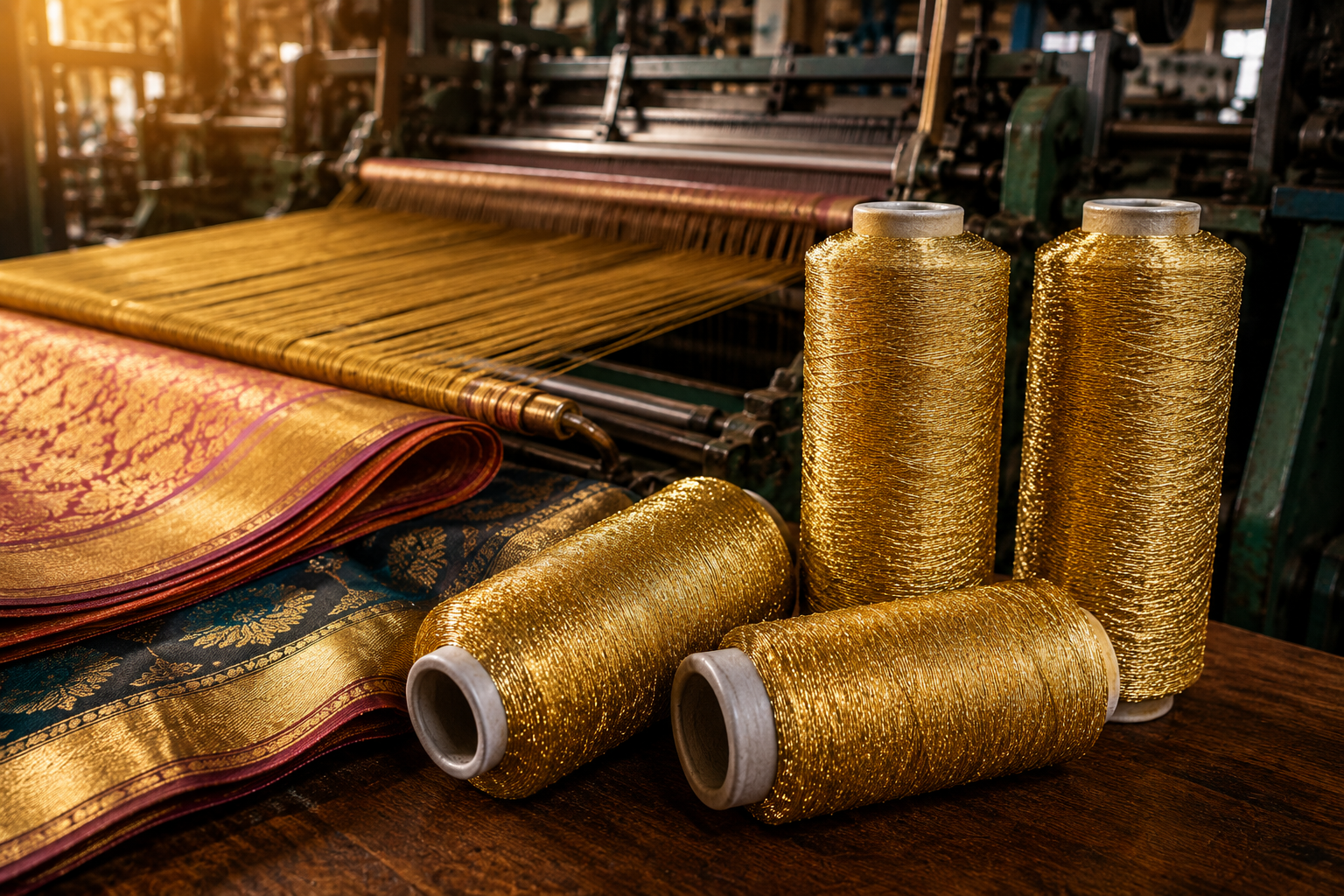
Metallic yarn is widely used to add shine, decorative effects and premium visual character to sarees, jacquard fabrics, embroidery, borders, ribbons and other textile products.
Although it may look like a simple golden or silver thread, metallic yarn production involves several controlled manufacturing stages. The characteristics of the finished yarn depend on factors such as the base film, coating, slit width, supporting yarn, twist and winding quality.
Understanding the manufacturing process helps textile manufacturers, weavers and sourcing teams select metallic yarn that is suitable for their machines and final applications.
What Is Metallic Yarn?
Metallic yarn is a decorative yarn containing a reflective metallic-looking component.
Modern metallic yarn is commonly produced using a thin polymer film that receives a metallic appearance through specialised coating or metallisation processes. The film is then converted into extremely narrow strips and may be twisted with supporting yarns depending on the required construction.
The result is a lightweight decorative yarn capable of creating gold, silver, copper and other metallic effects in textiles.
Step 1: Base Film Preparation
The process begins with the selection of a suitable thin film.
Polyester film is commonly used because it can provide:
- good dimensional consistency
- flexibility
- smooth surface characteristics
- compatibility with metallisation and coating processes
- suitability for precision slitting
The properties of the film influence the behaviour of the finished metallic yarn.
Consistency at this stage is important because variations can affect later processes such as cutting, twisting and weaving.
Step 2: Metallisation
The film is given its metallic appearance through a metallisation process.
A very thin metallic layer is deposited onto the film surface to produce a reflective finish.
This creates the characteristic shine associated with metallic yarn.
Depending on the required product, manufacturers can develop effects such as:
- gold
- silver
- copper
- rose gold
- antique shades
- customised metallic colours
The exact appearance can also be influenced by subsequent coatings and colour treatments.
Step 3: Protective and Colour Coating
After metallisation, additional coatings may be applied.
These coatings can serve several purposes, including protecting the metallic surface and creating the required colour or visual effect.
A metallic yarn intended for textile manufacturing must maintain a reasonably consistent appearance throughout production.
Uneven coating can lead to visible colour variation in woven or embroidered fabric.
For this reason, coating uniformity is an important quality consideration.
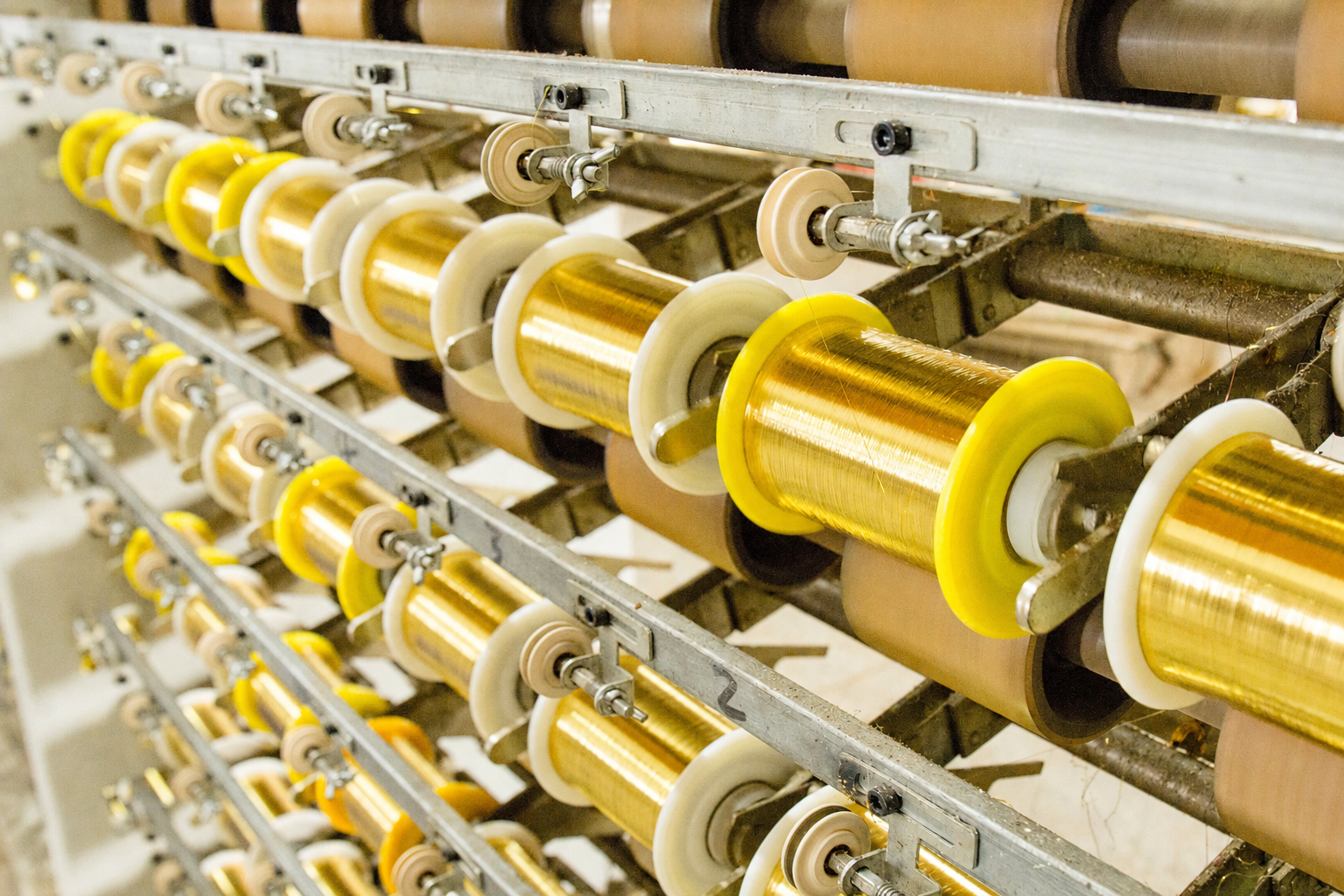
Step 4: Precision Slitting
The metallised film is initially much wider than the metallic strips eventually used in yarn.
It therefore passes through precision slitting equipment.
The film is cut into extremely narrow, consistent strips.
Slit width is an important parameter because it can influence:
- yarn appearance
- flexibility
- coverage
- handling
- weaving behaviour
- final fabric effect
Incorrect or inconsistent slitting can create irregular yarn performance.
Precision is therefore essential during this stage.
Step 5: Combining With Supporting Yarn
Depending on the metallic yarn construction, the narrow metallic strip may be combined with another yarn.
Supporting yarns can help provide the mechanical characteristics required by particular textile applications.
Different combinations may be selected depending on requirements such as:
- flexibility
- strength
- softness
- machine compatibility
- decorative appearance
This is one reason metallic yarn specifications should be selected according to the intended application rather than appearance alone.
Step 6: Twisting
The metallic component and supporting yarn may then be twisted together.
The amount of twist is commonly expressed in TPM — twists per metre.
TPM affects several characteristics of the yarn, including:
- construction stability
- appearance
- flexibility
- compactness
- handling during textile processing
A lower or higher TPM is not automatically better.
The correct twist depends on the yarn construction and the requirements of the weaving, embroidery or decorative process.
Step 7: Winding
Once the required yarn construction has been produced, the yarn is wound onto suitable packages such as cones or spools.
Good winding is important for downstream textile production.
The package should allow yarn to unwind smoothly without creating unnecessary tension variation or interruptions.
Manufacturers therefore monitor factors such as:
- winding tension
- package formation
- yarn alignment
- consistency
- package stability
Poor winding can create problems even when the yarn itself has been manufactured correctly.
Step 8: Quality Inspection
Before metallic yarn is supplied for textile production, relevant quality characteristics should be inspected.
Depending on the product and application, manufacturers may examine parameters such as:
Appearance
The metallic surface should have reasonably consistent colour, shine and finish.
Yarn Construction
The structure of the yarn should remain consistent throughout the package.
Denier
Denier is used to describe yarn linear mass and helps buyers understand the relative fineness or heaviness of a yarn specification.
TPM
Twist levels should remain within the required specification when twisted constructions are used.
Strength
The yarn should provide sufficient handling characteristics for its intended textile process.
Colour Consistency
Metallic shades should remain consistent between production lots where required.
Winding Quality
Packages should unwind smoothly during textile manufacturing.
Why Manufacturing Consistency Matters
Metallic yarn may pass through high-speed weaving, jacquard or embroidery machinery.
Small inconsistencies in the yarn can therefore become significant during production.
Possible problems caused by inconsistent yarn may include:
- yarn breakage
- uneven appearance
- weaving interruptions
- inconsistent metallic effect
- machine handling difficulties
- increased textile wastage
For B2B buyers, evaluating manufacturing consistency can therefore be just as important as choosing a particular colour.
Metallic Yarn for Saree Weaving
Metallic yarn is especially important in saree manufacturing.
It can be used for:
- borders
- pallu designs
- jacquard motifs
- decorative stripes
- butta patterns
- traditional-inspired metallic effects
However, the appropriate metallic yarn construction may differ according to the saree fabric, loom, design and required finish.
Manufacturers should therefore select specifications based on the complete application.
Metallic Yarn for Embroidery
Embroidery applications may require different characteristics from weaving.
Depending on the machine and embroidery design, considerations can include:
- flexibility
- surface smoothness
- twist
- yarn strength
- metallic coverage
- machine compatibility
Testing a sample before large-scale production can help confirm suitability.
How Should Buyers Select Metallic Yarn?
Before ordering metallic yarn for production, provide the supplier with as much application information as possible.
Useful details include:
- intended textile application
- loom or machine type
- required colour
- preferred denier
- preferred TPM
- yarn construction
- required quantity
- target appearance
- existing reference sample, if available
When the specification is uncertain, technical evaluation and sample testing can help determine a suitable option.
Frequently Asked Questions
What material is used to make metallic yarn?
Modern metallic yarn commonly uses a thin polymer film with a metallic-looking surface. Depending on the yarn construction, the metallic component may also be combined or twisted with supporting yarn.
How is gold metallic yarn made?
A metallic-looking film can receive additional colour or coating treatment to produce a gold effect. It is then slit into narrow strips and processed according to the required yarn construction.
Is metallic yarn made from real gold?
Most modern textile metallic yarn is designed to create a metallic appearance rather than being made from solid precious metal.
Why is metallic yarn twisted?
Twisting can combine the metallic component with supporting yarn and help create the required yarn structure, handling characteristics and appearance.
What is TPM in metallic yarn?
TPM means twists per metre. It indicates how many twists are present within one metre of yarn.
What is denier in metallic yarn?
Denier is a linear-density measurement used to describe the relative fineness or heaviness of a yarn or filament.
Choosing Consistent Metallic Yarn for Production
The performance of metallic yarn depends on more than its gold or silver appearance.
Film quality, coating, slitting accuracy, yarn construction, TPM, winding and quality control all contribute to how the yarn performs during textile manufacturing.
For manufacturers and sourcing teams, choosing the right specification and testing it in the intended application can help improve production consistency.
Suvarnatantu by Vastranand Pvt. Ltd. supports B2B requirements for metallic yarn and zari yarn across weaving, embroidery and decorative textile applications.
For application-specific requirements, buyers can request a sample or submit a quotation enquiry before bulk sourcing.