Metallic Yarn Trends in Saree, Jacquard and Embroidery Manufacturing
Explore key metallic yarn trends across saree weaving, jacquard, embroidery and decorative textiles, including evolving colours, finer constructions, customization and production-focused sourcing.
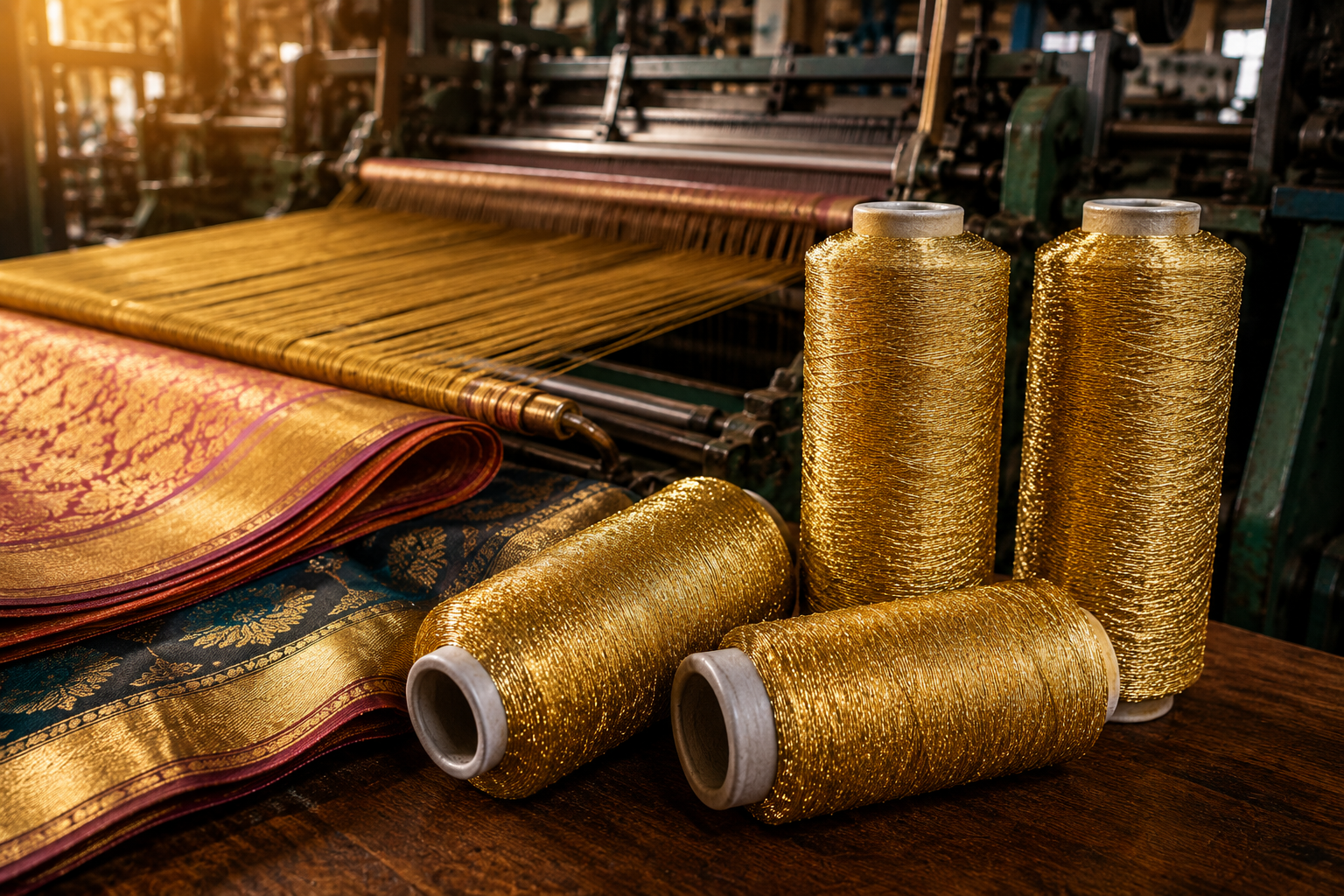
Metallic yarn has long been associated with decorative textiles, traditional weaving and premium fabric construction.
But its role in textile manufacturing continues to evolve.
Today, metallic effects are used not only for heavy traditional designs but also for subtle borders, contemporary jacquards, lightweight sarees, machine embroidery, fashion fabrics and decorative textile applications.
For manufacturers and sourcing teams, this means metallic yarn selection is becoming increasingly application-specific.
Instead of simply asking for “gold zari,” buyers are paying more attention to colour, denier, TPM, yarn construction, machine compatibility and final fabric appearance.
Here are some of the important trends shaping the use of metallic yarn in textile manufacturing.
1. Metallic Effects Are Becoming More Versatile
Metallic yarn was traditionally associated with rich, highly decorative textile designs.
That remains an important application, but manufacturers are also using metallic yarn in more restrained ways.
Examples include:
- narrow saree borders
- lightweight decorative stripes
- subtle jacquard motifs
- small butta designs
- contemporary embroidery
- fashion fabrics
- decorative trims
- accent weaving
This creates demand for metallic yarn constructions that can deliver visual impact without making the final textile unnecessarily heavy.
The desired yarn specification therefore depends heavily on how much metallic coverage is required in the finished fabric.
2. Gold Is No Longer the Only Important Shade
Traditional gold remains one of the most widely recognized metallic effects.
However, textile manufacturers increasingly work with a broader metallic colour palette.
Common requirements now include:
- bright gold
- light gold
- antique gold
- silver
- copper
- rose gold
- champagne-inspired tones
- custom metallic shades
Different shades can completely change the character of the textile.
For example, antique gold may create a more traditional appearance, while rose gold or softer metallic tones may complement contemporary fashion designs.
This makes shade consistency increasingly important for manufacturers working across repeated production lots.
3. Antique and Softer Metallic Finishes Are Important
Not every textile requires maximum shine.
Some applications benefit from a more controlled or aged metallic appearance.
Antique-style metallic shades can be useful for:
- traditional sarees
- heritage-inspired jacquard designs
- bridal textiles
- decorative borders
- premium fashion fabrics
A softer metallic appearance can provide richness without creating an excessively bright reflective effect.
For buyers, the final choice should be based on the fabric design rather than selecting the brightest yarn available.
4. Finer Metallic Effects Are Growing in Importance
Modern textile designs often require precise metallic detailing.
This can increase interest in finer yarn constructions for applications such as:
- detailed jacquard motifs
- lightweight sarees
- fine borders
- intricate embroidery
- small decorative patterns
However, finer yarn is not automatically better.
As yarn construction becomes finer, machine compatibility, strength and handling become increasingly important.
Manufacturers should test the yarn in the actual production environment before confirming large quantities.
5. Application-Specific Yarn Selection Is Increasing
One of the most important industry changes is the move away from treating metallic yarn as a single standard product.
A yarn specification suitable for saree weaving may behave differently in:
- embroidery
- jacquard weaving
- ribbon manufacturing
- decorative fabrics
- fashion textiles
Manufacturers increasingly need to specify:
- application
- denier
- TPM
- supporting yarn
- shade
- machine type
- expected finish
This helps suppliers recommend an appropriate construction instead of supplying one generic metallic yarn for every application.
Saree Manufacturing Trends
Sarees remain one of the major textile applications for zari and metallic yarn.
However, the way metallic effects are used varies significantly across fabric categories and design styles.
Lighter Metallic Borders
Some contemporary saree designs use narrower or lighter metallic borders instead of extremely heavy metallic sections.
This can create a more wearable fabric while retaining a premium appearance.
The required yarn therefore needs to balance:
visual brilliance + flexibility + fabric compatibility
Detailed Butta and Motif Work
Small metallic motifs can create high visual value without requiring full metallic coverage.
This is particularly relevant for jacquard and patterned weaving.
Consistent yarn construction is important because variations become visible across repeated motifs.
Contrast Metallic Effects
Manufacturers can also use metallic yarn as a contrast element.
For example:
- silver metallic yarn on darker fabrics
- antique gold on traditional colour palettes
- copper tones with earthy shades
- rose gold with softer contemporary colours
This creates more design possibilities than relying exclusively on conventional bright gold.
Jacquard Manufacturing Trends
Jacquard fabrics can use metallic yarn to produce detailed woven patterns.
Because jacquard designs may involve repeated motifs and precise yarn movement, consistency becomes particularly important.
Manufacturers should evaluate:
- yarn tension behaviour
- breakage
- winding quality
- colour consistency
- yarn construction
- loom compatibility
A visually attractive yarn that creates frequent machine stops may not be commercially suitable.
For production teams, the real objective is:
good design appearance + stable manufacturing performance
Embroidery Trends
Metallic embroidery continues to be used across ethnic wear, sarees, garments and decorative textiles.
Modern embroidery equipment can produce highly detailed metallic patterns, but metallic yarn behaves differently from conventional textile yarn.
Important considerations include:
- flexibility
- smoothness
- twist
- tension
- strength
- surface finish
- machine speed
Complex embroidery designs may require yarn testing before production.
This is especially important when introducing a new metallic construction or shade.
6. Custom Metallic Colours Are Becoming More Relevant
Textile brands and manufacturers increasingly develop their own colour stories.
As a result, customized metallic shades can become important for differentiated collections.
A custom requirement may involve matching:
- fabric colours
- design references
- existing yarn
- garment collections
- seasonal colour palettes
For accurate matching, a physical reference or approved colour sample can be more useful than describing a shade only as “gold” or “copper.”
7. Production Consistency Matters More Than Sample Appearance
A sample may look excellent, but B2B manufacturing requires consistency across larger quantities.
Manufacturers therefore need to consider:
- lot-to-lot shade consistency
- TPM consistency
- denier consistency
- winding quality
- yarn construction
- package formation
This is particularly important for repeat orders.
A textile factory may use the same yarn specification across several production cycles, making reliable repeatability essential.
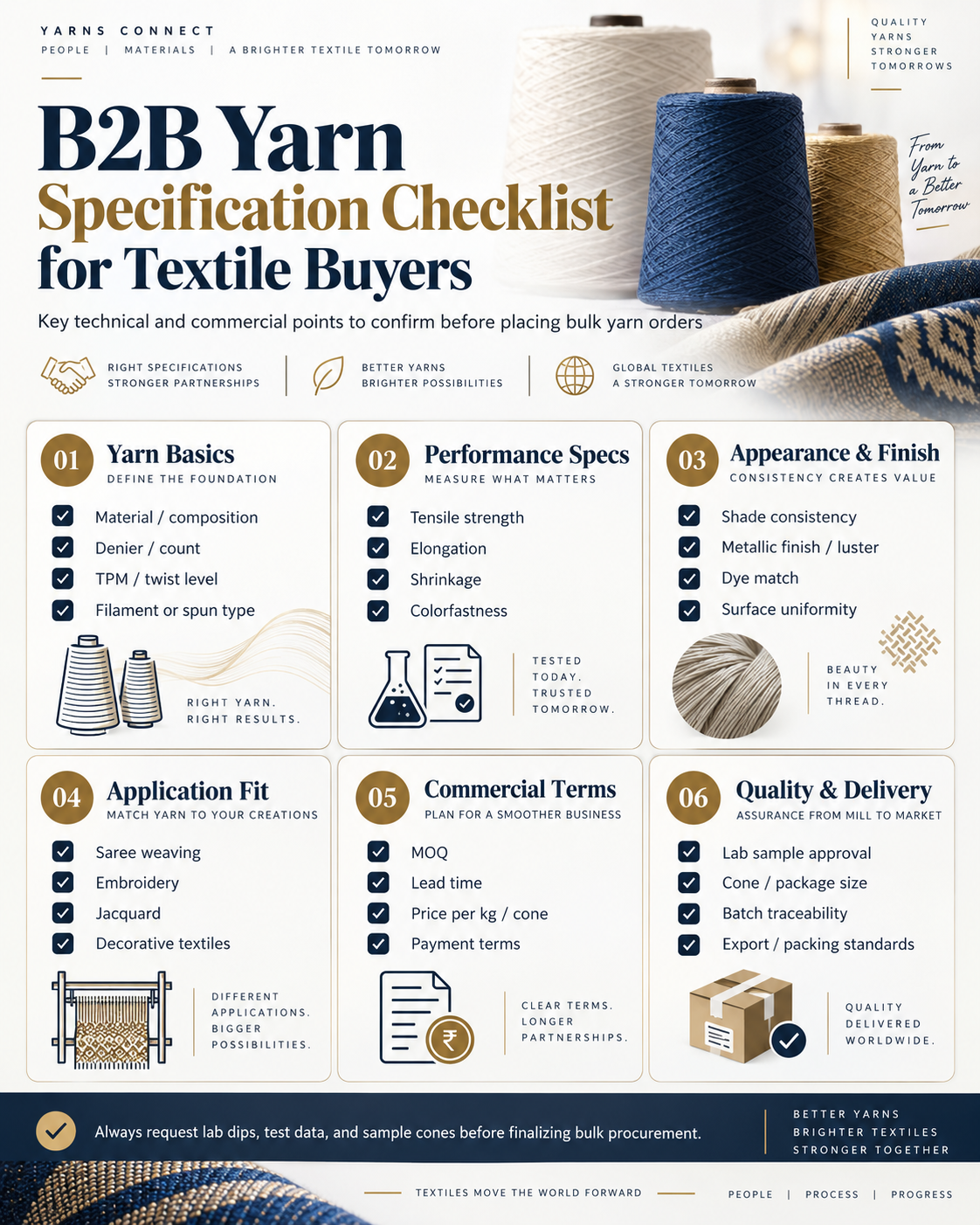
8. Buyers Are Paying More Attention to Technical Specifications
Metallic yarn sourcing is becoming more technical.
Instead of purchasing only by colour, professional buyers increasingly discuss specifications such as:
Denier
Denier helps describe the linear mass of a yarn or filament.
It can influence the visual character and performance of the final yarn.
TPM
TPM means twists per metre.
It affects yarn construction, compactness, flexibility and handling.
Supporting Yarn
Depending on the construction, metallic material may be combined with another yarn.
The supporting component can influence performance.
Slit Width
The width of metallic film strips can affect coverage, appearance and flexibility.
Understanding these parameters helps manufacturers compare products more accurately.
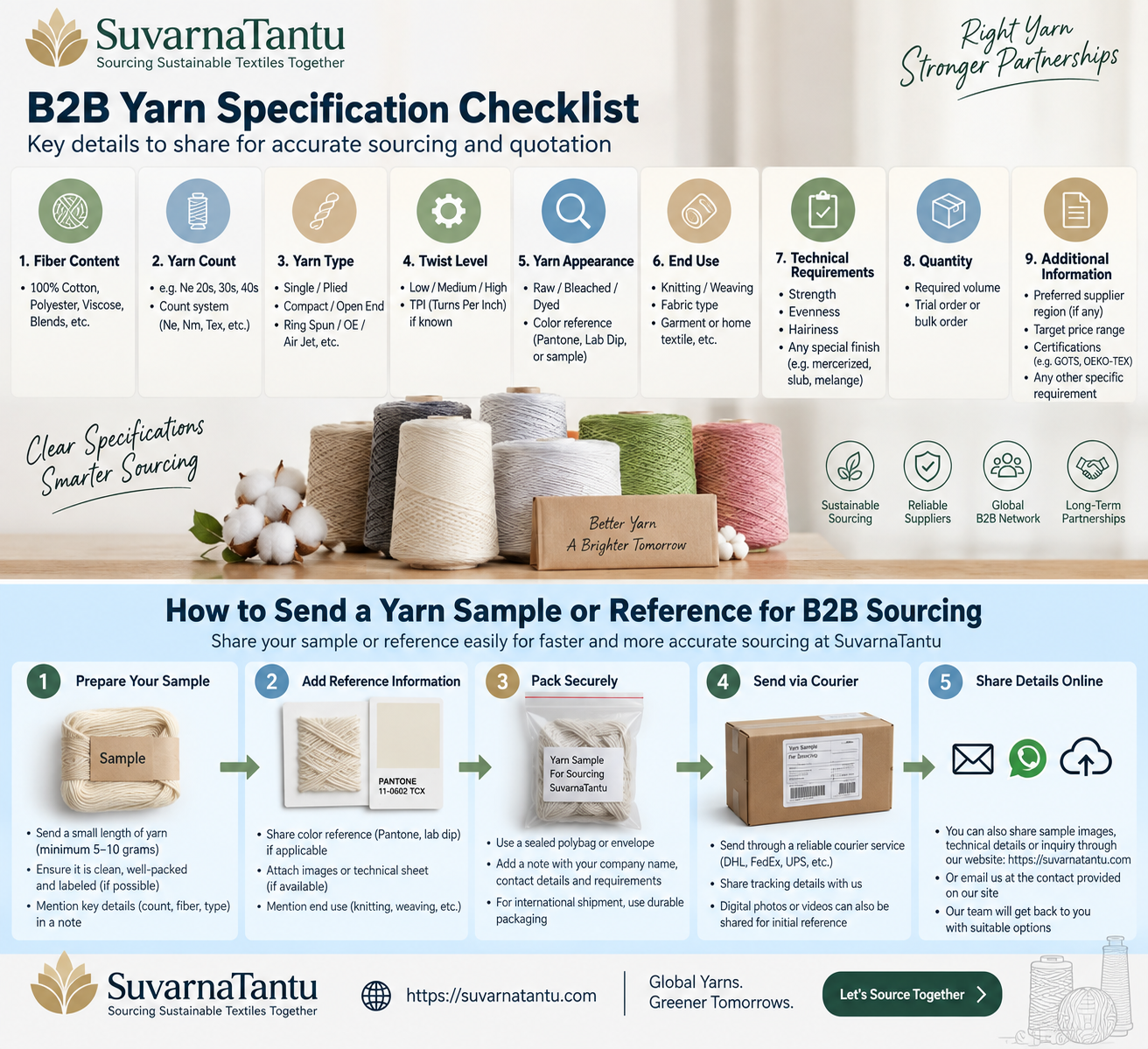
9. Sampling Before Bulk Orders Is Becoming Standard Good Practice
For technically sensitive textile applications, sampling is one of the best ways to reduce sourcing risk.
A trial allows manufacturers to evaluate:
- machine compatibility
- breakage
- tension
- shade
- fabric appearance
- metallic coverage
- production stability
The safest B2B sourcing flow is often:
Technical Requirement → Sample → Machine Trial → Bulk Order
This is particularly useful when a manufacturer is changing yarn suppliers or introducing a new yarn construction.
10. Manufacturing Efficiency Is Increasingly Important
Textile manufacturers ultimately need yarn that performs reliably in production.
A low-cost yarn that results in:
- repeated breakage
- machine stoppages
- poor winding
- inconsistent appearance
- increased wastage
can create higher overall production costs.
For this reason, yarn selection should consider the complete manufacturing impact rather than price alone.
11. Packaging and Supply Reliability Matter More for B2B Buyers
As manufacturers scale production, sourcing decisions also become operational decisions.
Buyers may need to evaluate:
- production capacity
- MOQ
- lead time
- packaging
- repeat-order capability
- logistics
- export support
A supplier that can provide an appropriate yarn but cannot consistently support production volumes may still create supply-chain risk.
12. Export Buyers Need Clearer Technical Communication
International sourcing introduces additional complexity.
An overseas buyer may not be able to visit the factory or physically compare several options before ordering.
Clear technical communication therefore becomes especially important.
Export buyers should ideally provide:
- product application
- denier
- TPM
- colour
- yarn construction
- quantity
- destination
- packaging requirement
- reference sample
This reduces misunderstandings between buyer and supplier.
What These Trends Mean for Textile Manufacturers
The direction of the industry is clear:
Metallic yarn sourcing is moving from a primarily visual purchase toward a more technical and application-driven decision.
Manufacturers increasingly need to balance:
Appearance
+
Machine Compatibility
+
Consistency
+
Production Efficiency
+
Supply Reliability
A yarn that performs well across all these areas can support more reliable textile production.
Questions Manufacturers Should Ask Before Selecting Metallic Yarn
Before confirming a specification, consider:
- What textile application will the yarn be used for?
- What metallic shade is required?
- What denier is suitable?
- What TPM is required?
- What supporting yarn or construction is needed?
- What loom or machine will be used?
- Is a production sample available?
- Can the supplier maintain lot consistency?
- What is the MOQ?
- What is the expected lead time?
- Can repeat orders maintain the same specification?
- Is export packaging or documentation required?
These questions help transform yarn sourcing from simple product buying into a more controlled manufacturing decision.
Frequently Asked Questions
What are the most common metallic yarn colours?
Gold and silver remain important, while copper, rose gold, antique gold and customized metallic tones are also used depending on textile design requirements.
Is metallic yarn only used in traditional sarees?
No. Metallic yarn can be used in sarees, jacquard fabrics, embroidery, fashion textiles, trims, ribbons and many decorative textile applications.
Why is metallic yarn specification important?
Specifications such as denier, TPM, yarn construction and colour can affect both the appearance and production performance of the yarn.
Should manufacturers test metallic yarn before bulk ordering?
Testing is recommended when using a new specification, supplier, machine application or fabric construction.
Can metallic yarn shades be customized?
Customization may be possible depending on the manufacturing process, quantity and required reference shade.
What matters most when sourcing metallic yarn?
The best specification should balance colour and appearance with machine compatibility, consistency, winding quality and supply reliability.
The Future of Metallic Yarn in Textile Manufacturing
Metallic yarn continues to evolve alongside textile design and manufacturing technology.
The future is likely to involve more:
- application-specific specifications
- customized colours
- finer decorative effects
- controlled antique finishes
- technically informed sourcing
- production-focused quality evaluation
For manufacturers, the opportunity is not simply to use more metallic yarn.
It is to use the right metallic yarn in the right construction for the right textile application.
Suvarnatantu by Vastranand Pvt. Ltd. supports B2B metallic yarn and zari yarn requirements for saree weaving, jacquard, embroidery and other decorative textile applications.