How to Choose a Metallic Yarn Supplier in India for B2B Textile Manufacturing
Learn what textile manufacturers and sourcing teams should evaluate when choosing a metallic yarn supplier in India, from specifications and consistency to samples, packaging and bulk supply.

Choosing a metallic yarn supplier is not only about finding the right gold or silver shade.
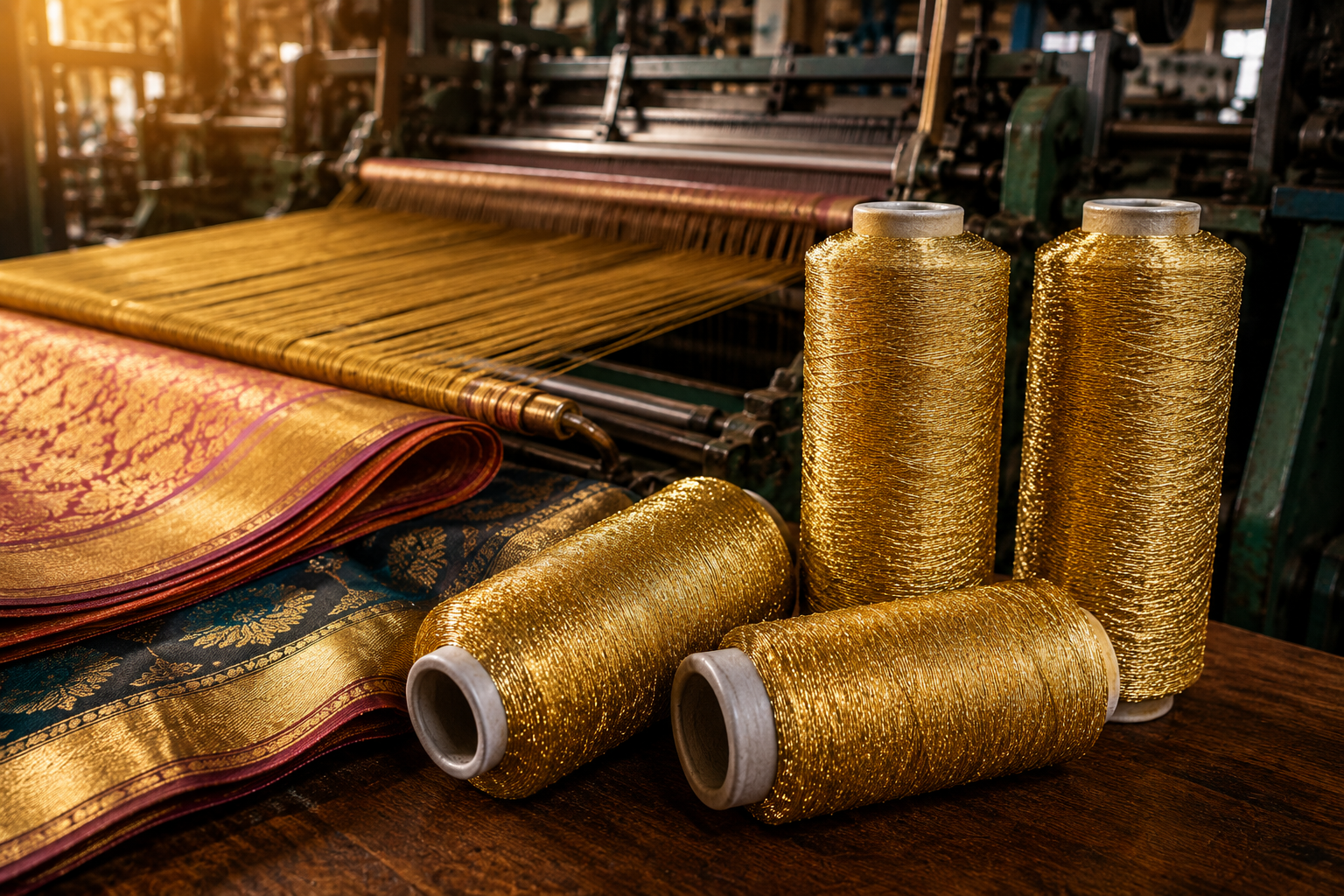
For textile manufacturers, saree weavers, embroidery units, jacquard producers and sourcing teams, the supplier must also be able to provide the right technical specification, consistent quality and dependable bulk supply.
Two metallic yarns may look similar when viewed on a cone, but they can behave very differently during weaving or embroidery.
This is why B2B buyers should evaluate metallic yarn suppliers on both commercial and technical factors before placing large production orders.
This guide explains the main points buyers should consider when sourcing metallic yarn from India.
1. Start With the Final Textile Application
The first step is to clearly define where the metallic yarn will be used.
A specification suitable for one application may not be suitable for another.
Common applications include:
- saree weaving
- jacquard fabric
- embroidery
- borders and trims
- decorative textiles
- ribbons
- fashion fabrics
- traditional textile designs
For example, metallic yarn used in saree weaving may need different handling characteristics from yarn used in machine embroidery.
A good supplier should therefore ask about the application before recommending a specification.
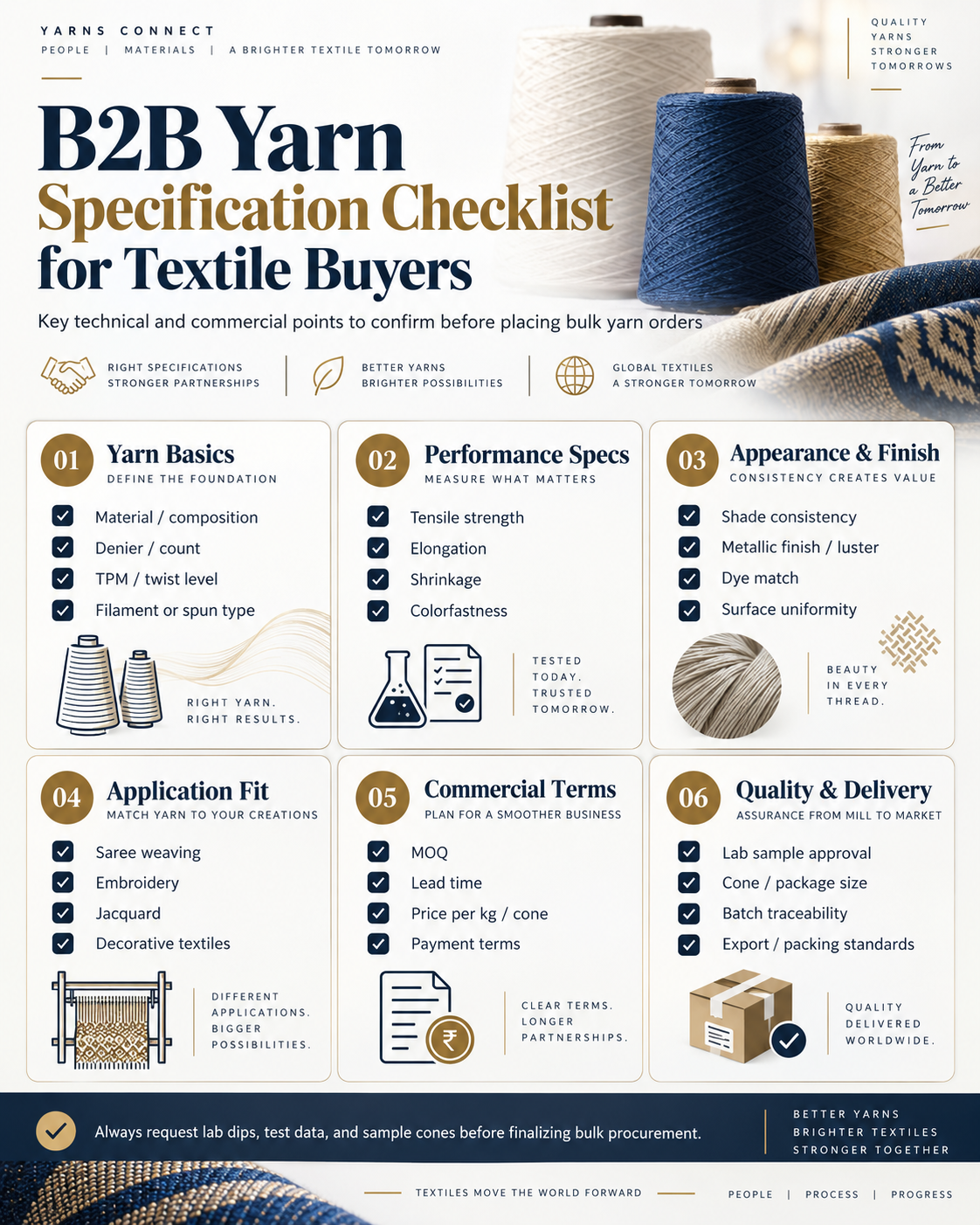
2. Confirm the Metallic Yarn Construction
"Metallic yarn" can describe several yarn constructions.
Before sourcing, buyers should understand exactly what they are purchasing.
Important questions include:
- What is the metallic component?
- Is the yarn twisted with a supporting yarn?
- What supporting yarn is used?
- What is the denier?
- What is the TPM?
- What is the final yarn construction?
- What colour or finish is required?
The correct construction depends on the intended textile process.
A sourcing decision based only on visual appearance can create problems once the yarn reaches the loom or embroidery machine.
3. Check Denier
Denier describes the linear mass of a yarn or filament.
In practical sourcing discussions, it helps manufacturers compare how fine or heavy different yarn specifications are.
Denier may influence:
- yarn feel
- coverage
- visual effect
- fabric weight
- machine behaviour
- suitability for particular textile constructions
Buyers should avoid assuming that one denier is universally better.
The correct denier depends on the fabric, machine and required final appearance.
If you are unsure about denier, request technical guidance or samples before confirming the bulk specification.
4. Check TPM
TPM means twists per metre.
It indicates how many twists are present within one metre of yarn.
TPM can affect:
- yarn compactness
- flexibility
- construction stability
- appearance
- handling during textile processing
Both very low and very high twist levels can change how the yarn behaves.
For B2B sourcing, the important point is consistency.
A supplier should be able to maintain the agreed twist specification across production quantities.
5. Evaluate Colour and Finish Consistency
Metallic yarn is often selected for its visual impact.
Therefore, colour consistency is extremely important.
Typical metallic shades include:
- gold
- silver
- copper
- rose gold
- antique gold
- custom shades
A colour that looks slightly different on individual yarn packages can become very noticeable across a large woven fabric.
When sourcing for continuous production, buyers should ask how the supplier manages colour consistency between production lots.
For projects where shade matching is critical, provide a physical reference whenever possible.
6. Request Samples Before Bulk Production
A sample is one of the most useful tools in B2B yarn sourcing.
It allows your production team to test the yarn on the actual machine and fabric.
Sample testing can help evaluate:
- yarn appearance
- machine compatibility
- breakage
- flexibility
- tension behaviour
- final fabric effect
- shade compatibility
A sample that looks good in the hand may still behave differently in production.
Whenever the requirement is new or technically sensitive, production testing should happen before a large order is confirmed.
7. Check Weaving or Machine Compatibility
Your supplier should understand that metallic yarn is ultimately a production material.
The important question is not simply:
"Does the yarn look good?"
It is:
"Will this yarn perform properly in my production process?"
Provide information such as:
- loom type
- embroidery machine type
- jacquard application
- fabric construction
- production speed
- existing yarn reference
- expected final appearance
The more technical information a supplier receives, the easier it becomes to recommend an appropriate specification.
8. Evaluate Yarn Strength and Handling
Metallic yarn passes through guides, tensioning systems, needles or weaving mechanisms depending on the application.
Poor handling properties can result in:
- yarn breakage
- frequent machine stops
- inconsistent fabric
- production waste
- lower efficiency
For this reason, manufacturers should evaluate yarn performance under actual production conditions.
A supplier should not promise that one specification will work for every application.
Testing remains an important part of responsible sourcing.
9. Examine Winding Quality
Winding quality is sometimes overlooked during yarn sourcing.
However, even a good yarn can create problems if the package is badly wound.
A properly prepared package should support smooth unwinding during production.
Buyers should look for:
- uniform package formation
- consistent winding
- stable cones or spools
- minimal tangling
- reliable unwinding
Poor winding can create unnecessary production interruptions.
For high-volume textile manufacturing, this can become a significant operational issue.
10. Ask About Lot Consistency
One sample may perform perfectly.
The next question is whether the same performance can be maintained across the full production quantity.
For B2B buyers, consistency between lots is important for:
- colour
- denier
- TPM
- yarn construction
- winding
- visual appearance
If your manufacturing program requires repeated purchases, discuss ongoing specification consistency with the supplier before establishing regular sourcing.
11. Communicate Quantity Requirements Clearly
Metallic yarn suppliers need to understand the expected order scale.
Provide approximate requirements such as:
- sample quantity
- trial quantity
- monthly consumption
- bulk order quantity
- repeat order frequency
This helps the supplier evaluate production planning and provide a more appropriate quotation.
For a new specification, it can be sensible to progress through:
Sample → Production Trial → Bulk Order
rather than moving directly to a very large order.
12. Discuss Packaging Requirements
Packaging is especially important for buyers who transport yarn between cities or countries.
The packaging should protect the yarn packages from:
- crushing
- contamination
- moisture exposure
- excessive movement
- handling damage
For export requirements, buyers may also need specific carton markings, documentation or packing arrangements.
These requirements should be communicated before dispatch rather than after the goods have been packed.
13. Consider Export and Logistics Requirements
International buyers need to evaluate more than the yarn itself.
Before ordering, clarify:
- destination country
- required quantity
- shipping method
- packaging requirements
- documentation requirements
- delivery expectations
- Incoterms where applicable
The best logistics method depends on shipment volume, destination and urgency.
Small trial quantities may require a different shipping approach from regular commercial consignments.
14. Compare Suppliers on More Than Price
Price is important in B2B sourcing, but the cheapest yarn may not produce the lowest overall manufacturing cost.
Consider what happens if a lower-priced yarn causes:
- increased breakage
- machine downtime
- fabric rejection
- colour inconsistencies
- higher wastage
- production delays
When comparing suppliers, evaluate the complete sourcing value:
Specification + Quality + Consistency + Service + Price
rather than price alone.
15. Ask for Technical Communication
B2B textile requirements often need discussion before a final specification is selected.
A useful supplier should be able to communicate clearly about:
- product construction
- denier
- TPM
- colour
- application
- sample requirements
- production quantities
When requirements are unclear, technical discussion can prevent an incorrect order.
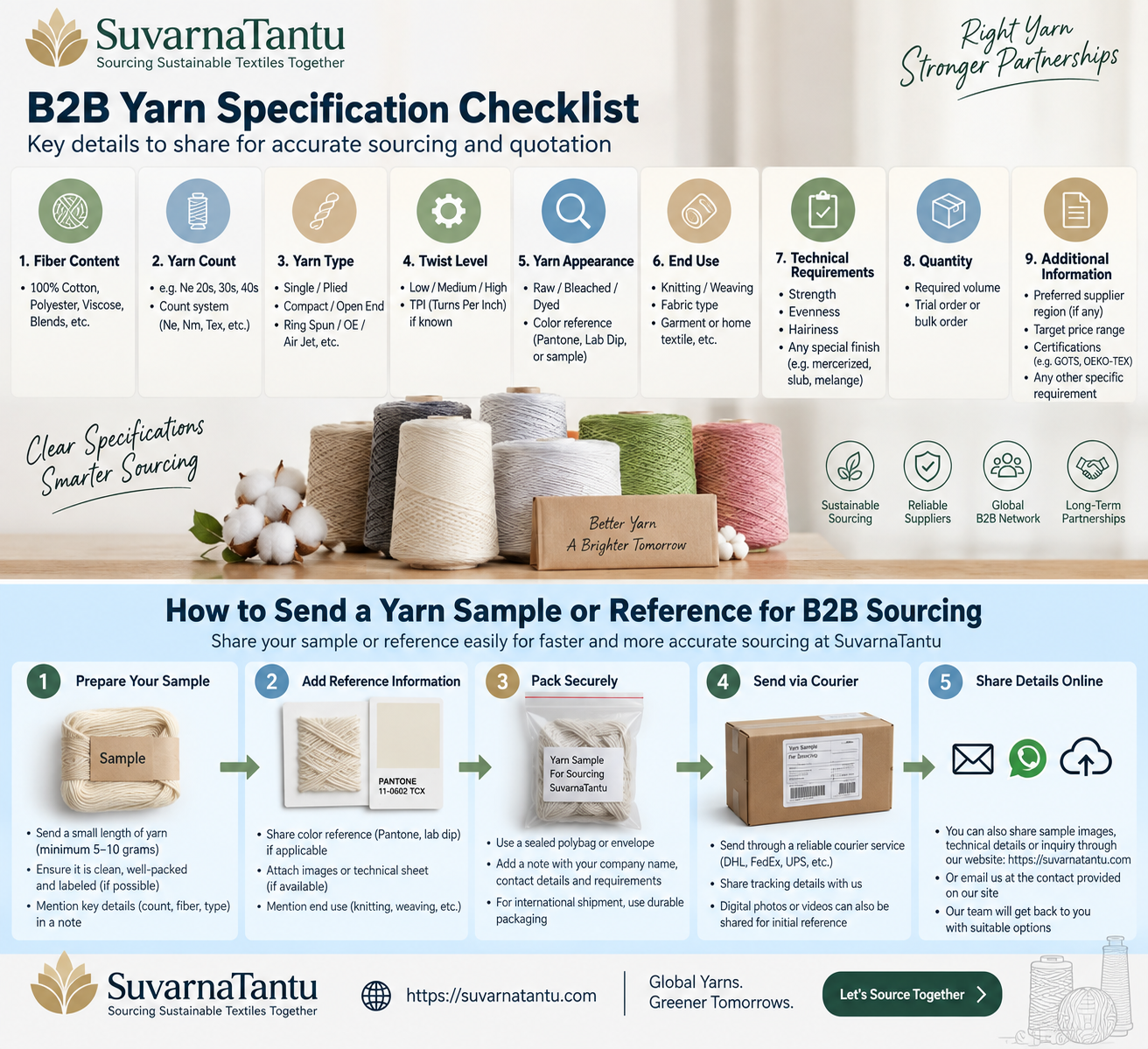
Information to Send When Requesting a Metallic Yarn Quote
To receive a more accurate quotation, provide the supplier with:
Product
Metallic yarn or zari yarn.
Application
For example:
Saree weaving, jacquard, embroidery or decorative textile.
Colour
Gold, silver, copper, rose gold, antique or custom shade.
Denier
Provide the required specification if already known.
TPM
Provide the required twist specification if applicable.
Quantity
Trial or bulk quantity.
Machine / Loom
Include relevant information where possible.
Delivery Location
City and country.
Reference Sample
Share an existing yarn or fabric reference if matching is required.
Providing these details at the beginning can make the sourcing process significantly more efficient.
Questions B2B Buyers Should Ask a Metallic Yarn Supplier
Before placing a bulk order, consider asking:
- Can you provide a sample for testing?
- What denier options are available?
- What TPM specifications are available?
- Can you match a reference shade?
- How is lot consistency controlled?
- What packaging options are available?
- What is the MOQ for my specification?
- What is the expected production lead time?
- Can you support repeat orders?
- Can the yarn be supplied for export requirements?
The answers can help buyers understand whether a supplier is suitable for long-term sourcing.
Frequently Asked Questions
Where can I source metallic yarn in India?
India has metallic yarn manufacturers and suppliers serving weaving, embroidery, saree and decorative-textile industries. Buyers should compare suppliers based on technical specification, consistency, samples and production capability rather than location alone.
What should I check before buying metallic yarn?
Important factors include application, yarn construction, denier, TPM, colour, winding quality, production consistency and machine compatibility.
Should I request a sample before placing a bulk order?
For a new specification or production application, sample testing is strongly recommended. It helps confirm machine compatibility and the final textile appearance before a larger order.
Can metallic yarn be customized?
Depending on manufacturing capability, suppliers may offer different metallic colours, yarn constructions, denier and twist specifications. Custom requirements should be discussed before production.
What is the MOQ for metallic yarn?
MOQ varies according to product construction, colour, specification and manufacturer. B2B buyers should provide the complete requirement to receive an accurate MOQ and quotation.
Can metallic yarn be exported from India?
Metallic yarn can be supplied internationally, subject to the supplier's export capability and applicable logistics, documentation and destination requirements.
Building a Reliable Metallic Yarn Supply Chain
A reliable metallic yarn supplier should do more than provide a visually attractive product.
For long-term textile manufacturing, buyers should focus on:
correct specification → sample testing → production consistency → reliable supply
This approach can reduce sourcing risk and help manufacturing teams achieve more consistent textile production.
Suvarnatantu by Vastranand Pvt. Ltd. works with B2B requirements for metallic yarn and zari yarn across weaving, embroidery, saree manufacturing and decorative textile applications.